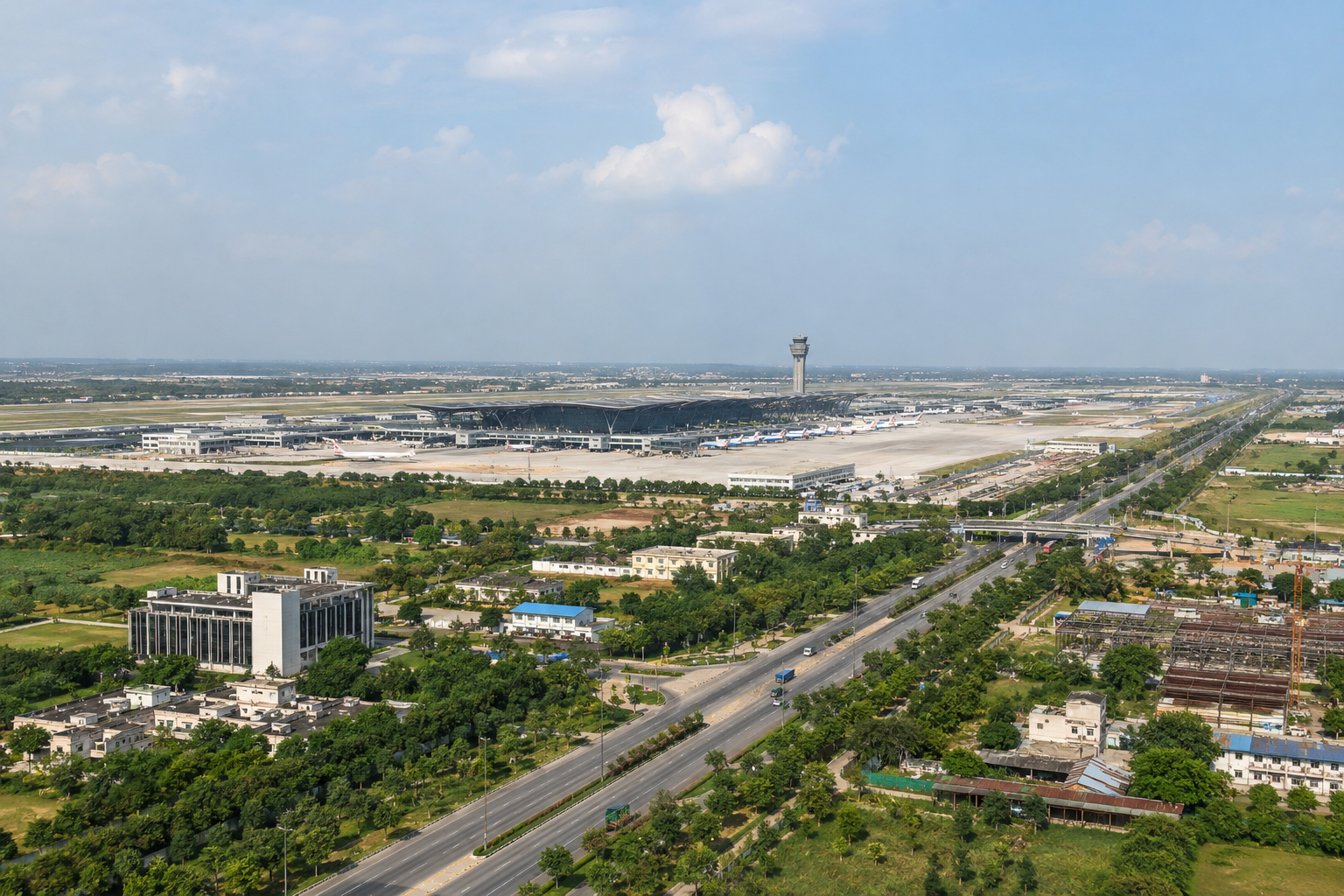
The Jewar Aviation Effect: Long-Term Real Estate Yield Projections Around Noida International Airport
Jewar’s new airport is changing the way investors look at the Yamuna Expressway, with growing cargo, industrial and employment activity likely to shape property demand and returns over the next decade.
Jewar’s new airport is changing the way investors look at the Yamuna Expressway, with growing cargo, industrial and employment activity likely to shape property demand and returns over the next decade.
Scheduled commercial flights began from Jewar on June 15, 2026, turning a long-awaited infrastructure project into an operating part of the NCR economy. Cargo operations followed two days later, giving the Yamuna Expressway an immediate logistics role alongside passenger traffic. Phase I has been designed for 12 million passengers annually.
That changes the property story. Investors entering in 2026 are no longer buying only on the promise of future connectivity. They are assessing whether freight, factories, offices and employment can create enough real demand to support property values over the next decade.
Why Jewar is entering a new phase
The airport is becoming one part of a much wider economic corridor. YEIDA's planning includes industrial, logistics, commercial, institutional and residential uses, giving the region several potential sources of property demand rather than relying entirely on housing.
The shift can already be seen in the airport's commercial infrastructure. Its cargo terminal is designed for air freight, warehousing and multimodal movement, while the wider YEIDA plan provides for logistics parks, warehouses, cold storage and related facilities.
For investors, this creates a useful distinction:
Land value depends heavily on future expectations.
Rental value depends on someone needing to occupy the property.
Long-term appreciation depends on whether the surrounding economy keeps expanding.
The third factor will matter most as the market matures.
Cargo is changing the property equation
The first cargo flight arrived on June 17 carrying nearly 20 tonnes of mixed goods, including perishables, auto components and mobile devices. The flight was handled through the AISATS Multi Modal Cargo Hub.
That is a small beginning compared with the airport's planned cargo capacity, but it gives the industrial story a real starting point.
Cargo can support demand for:
Modern warehouses and distribution centres
Freight-forwarding offices
Cold-storage facilities
Packaging and consolidation units
Trucking and transport services
Industrial support space
This is where the airport can have a stronger effect on commercial property than on ordinary housing. A logistics company has a direct business reason to pay for efficient access to air and road freight.
Industrial growth is widening demand
The long-term property opportunity will depend heavily on how quickly businesses establish themselves around the airport.
YEIDA's 2041 planning includes logistics parks, industrial areas and specialised uses such as cold storage and freight complexes. Sector 33, for example, is planned for large industrial plots, with peripheral road construction underway while water, sewerage and drainage infrastructure remains under design.
That last detail is worth noting. It shows why investors should not treat every planned sector as an immediately mature market.
A land allotment is not a factory. A proposed road is not a working road. A planned business district is not an occupied business district.
The strongest investment signals will come from completed infrastructure, operating companies and actual employment.
Where investors could find the best opportunities
There is no reliable official source forecasting the exact 2036 return of each property category. The following figures are therefore scenario ranges for comparison, not guaranteed investment returns.
Asset class | 2036 growth scenario | Gross yield scenario | Main demand |
|---|---|---|---|
Grade-A logistics | 9%–13% | 7%–9.5% | Cargo and industry |
Serviced accommodation | 7%–10% | 5.5%–7.5% | Staff and visitors |
Commercial offices | 7%–11% | 6%–8% | Business services |
Transit retail | 6%–9% | 5%–7% | Workers and commuters |
Residential | 6%–9% | 3%–4.5% | Employees and families |
Logistics has the clearest income case. A well-specified warehouse can serve several industries and may benefit from longer corporate leases. Investors should still calculate net income after maintenance, insurance, vacancy and capital expenditure.
Serviced accommodation is more specialized. Engineers, consultants, contractors and aviation staff may create demand for furnished units. The higher potential income comes with higher operating and management costs.
Commercial property needs actual tenants. Offices and retail space can perform well once employment and footfall become established, but early supply can remain vacant for longer than expected.
Residential property has a longer runway. Homes will benefit as jobs and communities grow, but schools, healthcare, retail and daily connectivity will determine whether residents actually choose to live nearby.
What to check before buying
The market's rapid development makes basic due diligence essential. Buyers should focus on what can be verified today rather than paying a full premium for future promises.
YEIDA records: Check allotment, land use and development status.
RERA: Verify UP-RERA registration and approvals where applicable.
Road access: Visit the property and test the route during working hours.
Utilities: Confirm electricity, water, drainage and other services.
Rental evidence: Compare rents from occupied properties nearby.
Commercial leases: Examine tenant quality, lease duration and escalation terms.
Exit demand: Decide who is likely to buy the asset when you eventually sell.
YEIDA's own building-plan system requires property approvals and completion applications to be processed through its online system, while industrial plot applications are routed through Nivesh Mitra. That makes official documentation especially important when checking a development's status.
What could go wrong
The biggest risk is not necessarily the airport itself. It is a mismatch between property supply and economic demand.
If apartments, offices and shops are delivered faster than factories, companies and workers arrive, rental growth can remain weak. Property prices may still rise, but owners could discover that their income returns do not justify the purchase price.
Infrastructure timing is another concern. Sector 33, for example, still has utility works at the design and estimating stage. That is a reminder that development across the wider corridor will not happen at the same speed everywhere.
Investors should therefore separate three things when valuing a property: what is operating, what is approved and what is only proposed.
What the next 10 years could bring
The first Jewar property cycle was built around anticipation. The 2026 to 2036 cycle will be judged by occupancy and income.
Cargo volumes, industrial production, office leasing, residential rents and employment will reveal whether the airport is creating a lasting economic ecosystem. If those indicators strengthen together, the effect should spread beyond the terminal into logistics parks, commercial districts and residential communities.
The most defensible opportunities will not simply be the properties closest to the airport. They will be assets where business demand, usable infrastructure and recurring income meet.
That is the real shift taking place in Jewar. The airport has opened. The next question is how much of the surrounding property market can turn that connectivity into sustainable economic value.
References
Noida International Airport | First commercial flights begin
Noida International Airport | Cargo and logistics
Yamuna Expressway Industrial Development Authority | YEIDA 2041 master plan
Yamuna Expressway Industrial Development Authority | Industrial sector 33
Business Standard | First cargo flight begins operations