Why Delhi’s farmhouses are becoming modern private estates
Delhi’s wealthy families are abandoning crowded urban floors for permanent private estates in South Delhi’s green belts. Driven by high prices and a desire for control, buyers in Rajokri and Sultanpur are prioritizing privacy, advanced air filtration, and land over sheer house size.
Delhi’s wealthy families are abandoning crowded urban floors for permanent private estates in South Delhi’s green belts. Driven by high prices and a desire for control, buyers in Rajokri and Sultanpur are prioritizing privacy, advanced air filtration, and land over sheer house size.
Delhi’s farmhouse market is moving beyond the traditional weekend property. Across Rajokri, Westend Greens, Sultanpur and other established South Delhi green belts, wealthy families are increasingly treating large parcels as permanent private estates, with greater emphasis on privacy, security, modern architecture and year-round family living. The change is not simply about building larger houses. It is about controlling the land around them and creating a self-contained residential environment.
Why wealthy Delhi families are moving beyond builder floors
South Delhi addresses such as Vasant Vihar and Greater Kailash remain prestigious, but redevelopment has changed the residential equation. Independent luxury floors have become increasingly expensive, with a 2,500 sq ft floor in some Category-A colonies reaching ₹14 crore to ₹25 crore in 2025, according to a 2026 report.
For affluent buyers, a private estate offers something a builder floor cannot easily provide:
Private entrance and driveway
Independent perimeter security
Dedicated landscaping
Large outdoor areas
Guest accommodation
Separate service circulation
Private parking
Family recreation spaces
The premium is therefore increasingly about control over the property, not simply the size of the residence.
The land market is divided into distinct micro-markets
South Delhi farmhouse values vary according to location, title, permitted land use, airport access, road connectivity and neighbourhood exclusivity. The following figures are indicative estimates supplied for this analysis, not official transaction benchmarks.
Belt | Indicative land rate per sq yd | Approx. land cost per acre | Indicative estate value | Typical buyer profile |
Westend Greens and Rajokri | ₹1.10 lakh to ₹1.35 lakh | ₹55 crore to ₹65 crore | ₹120 crore to ₹250+ crore | Conglomerate promoters, legacy industrialists |
Sultanpur and Prakriti Marg | ₹1.40 lakh to ₹1.50 lakh | ₹70 crore to ₹73 crore | ₹100 crore to ₹180 crore | Tech founders, senior legal and PE professionals |
DLF Chattarpur Farms | ₹1.15 lakh to ₹1.35 lakh | ₹60 crore to ₹65 crore | ₹80 crore to ₹150 crore | Developers, multigenerational business families |
Gadaipur and Radhe Mohan Drive | ₹1.00 lakh to ₹1.25 lakh | ₹48 crore to ₹60 crore | ₹65 crore to ₹120 crore | Global NRIs, private investors |
Individual properties can differ substantially from these ranges because construction quality, title, access, landscaping and development potential can materially affect value.
The logistics problem is becoming less important
The farmhouse once carried a practical disadvantage: distance from everyday services. That matters less for strategically located estates with good connections to South Delhi, Gurgaon and the airport. For the right property, the location can provide access to:
Major arterial roads
Gurgaon’s corporate districts
Indira Gandhi International Airport
Premium retail and hospitality
Private healthcare
Established South Delhi neighbourhoods
Infrastructure still needs to be checked property by property, particularly water, power, drainage, internet connectivity and road access.
The new architecture is built around year-round living
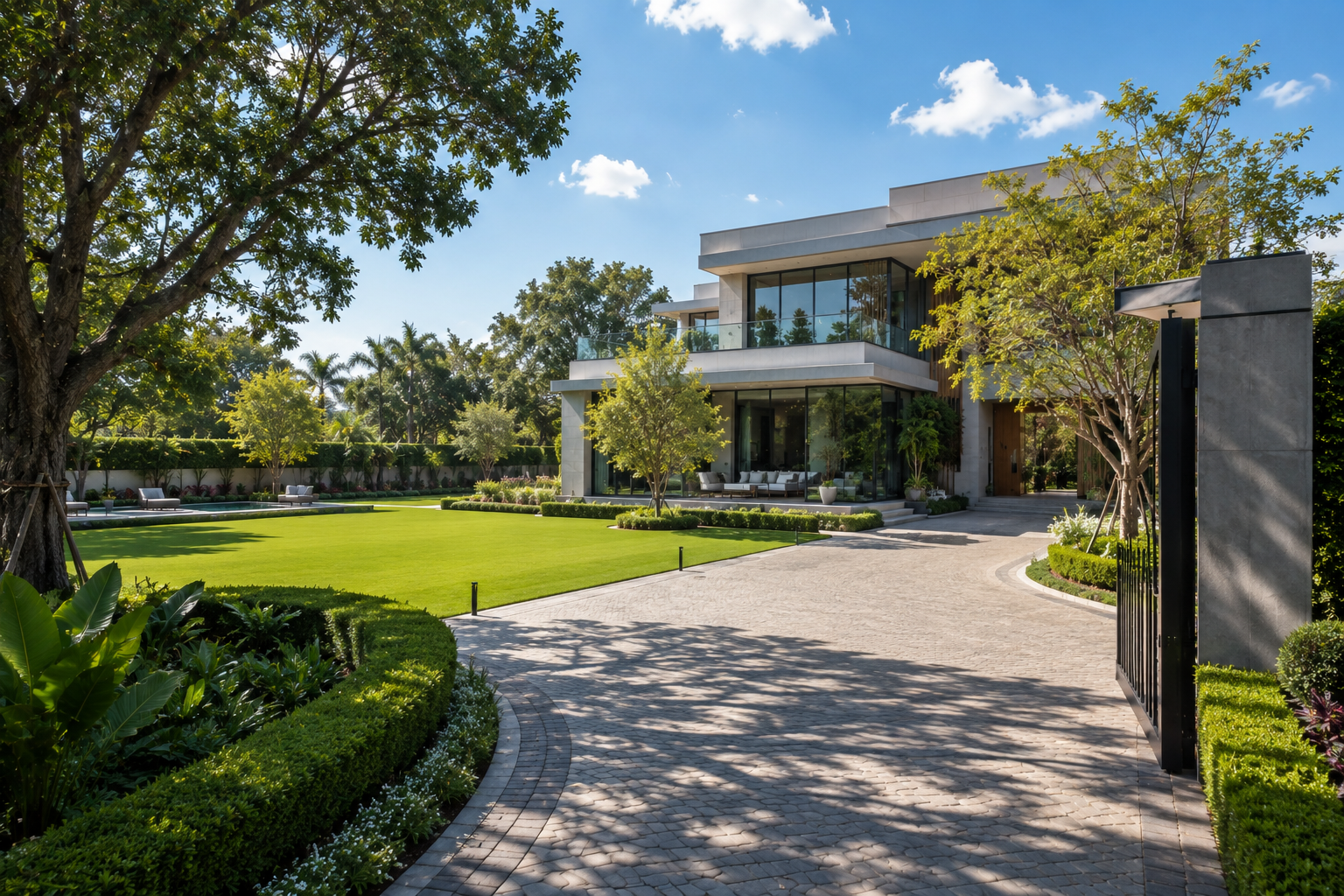
Modern farmhouse architecture is moving away from ornate facades toward lower-profile contemporary designs, natural materials, landscaped courtyards and stronger indoor-outdoor connections. Current luxury listings in South Delhi farmhouse belts commonly feature pools, lawns, guest accommodation, gyms and dedicated service facilities. The more important change is functionality. Modern estates can separate family areas from staff operations, provide independent guest spaces and create outdoor areas designed for regular use rather than occasional events.
Typical planning now focuses on:
Private family wings
Guest suites
Home offices
Staff accommodation
Swimming pools
Wellness rooms
Outdoor dining
Entertainment areas
Air quality and security are becoming design priorities
Delhi NCR’s air quality has made indoor environmental control more relevant to premium residential design. New homes can incorporate advanced filtration and controlled ventilation, while landscaping and building orientation can create more protected outdoor areas.
Security is also being integrated into the estate itself. Depending on the property, systems may include:
Controlled vehicle access
CCTV and perimeter monitoring
Automated gates
Visitor management
Dedicated security facilities
Separate service entrances
For ultra-high-value homes, these are increasingly treated as core infrastructure rather than optional extras.
Why land matters more than another luxury room
At the highest end of the market, additional land can be more valuable than another bedroom or oversized living room. A larger parcel provides space for privacy, mature landscaping, recreation and future family requirements. DDA planning material identifies Chattarpur, Satbari, Gadaipur, Sultanpur and Rajokri among areas within the Low Density Residential Area framework and maintains specific policies relating to farmhouses and development. Before purchasing, buyers should verify:
Ownership and title
Land-use status
Construction permissions
Development controls
Property boundaries
Access rights
Existing approvals
Redevelopment restrictions
The distinction between valuable land and a legally straightforward development opportunity is critical in this market.
What makes a farmhouse a true private estate?
Price alone does not create an ultra-luxury estate. The strongest properties combine:
Rare land: substantial and strategically located
Privacy: meaningful separation from surrounding properties
Architecture: designed specifically for the site
Infrastructure: dependable utilities and service systems
Security: integrated access and perimeter protection
Lifestyle: pools, gardens, wellness and entertainment
Family planning: accommodation for multiple generations
Longevity: potential to remain useful as a family asset
This combination separates a genuine private estate from an expensive farmhouse with a large building.
Delhi’s luxury market is moving from display to control
The transformation is ultimately about what wealthy buyers want to control. A modern private estate provides greater authority over the land, entrance, landscaping, security, outdoor spaces and daily household operations. For Delhi’s wealthiest families, the farmhouse is therefore becoming more than a secondary residence. It is evolving into a permanent private estate where land and privacy can matter as much as the architecture itself. The strongest properties will not necessarily be the ones with the largest mansions. They will be the estates that combine scarce land, a defensible location, mature surroundings and a design built around the family’s long-term needs.
References
The Economic Times: Farmhouses, plots near Delhi NCR see demand surge as city homes get costlier
The Economic Times: Avg rates of independent floors in south Delhi's housing colonies up 22-34 pc last yr
Delhi Development Authority (DDA): Master Plan for Delhi (MPD) 2021
Delhi Development Authority (DDA): Policies and Guidelines (LDRA & Farmhouse Regularisation)