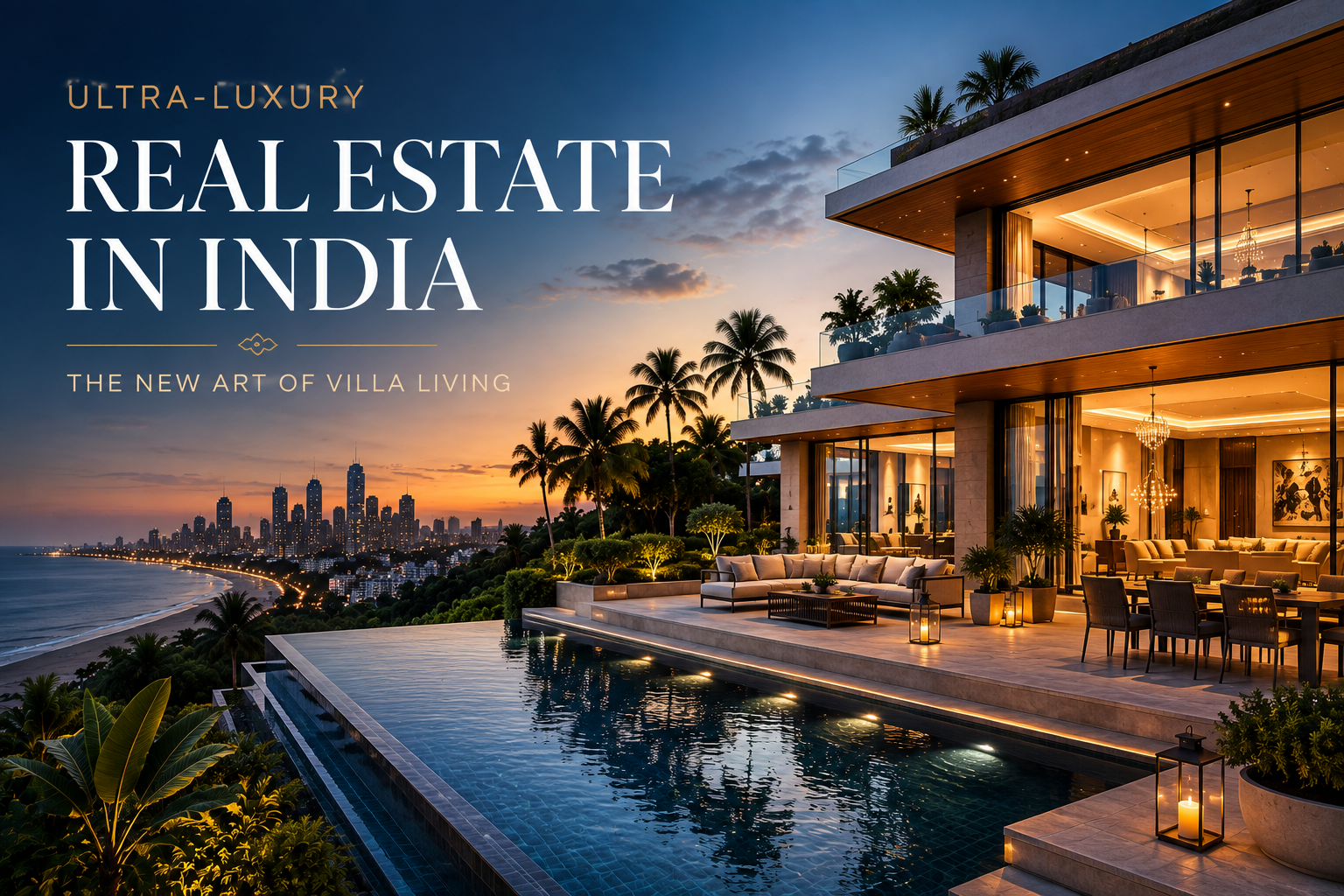
Ultra-luxury real estate in India: The new art of villa living
Discover how ultra-luxury villas in India are redefining private living through exceptional design, privacy, wellness, outdoor spaces and effortless service, creating residences shaped around the lifestyle of discerning buyers.
Discover how ultra-luxury villas in India are redefining private living through exceptional design, privacy, wellness, outdoor spaces and effortless service, creating residences shaped around the lifestyle of discerning buyers.
Ultra-luxury real estate in India: The new art of villa living
Ultra-luxury real estate in India is moving beyond the traditional equation of size, expensive materials and elaborate amenities. For affluent buyers, the more important question is how well a residence supports everyday life. Privacy, thoughtful architecture, landscape, wellness and effortless entertaining increasingly define the experience. The finest villas are not necessarily the most dramatic. Their quality becomes clearer after ownership, when good design begins to remove small inconveniences from daily routines.
When square footage stops telling the whole story
A large floor plan does not automatically create comfort. Two villas with similar areas can feel completely different when occupied. One may have oversized rooms connected by inefficient circulation, while another may use space more deliberately, separating family, guest, working and private areas without making the home feel divided.
The property also extends beyond its built area. The approach, entrance, garden, terraces, pool, views and service areas all influence how the residence feels. A carefully planned villa creates a gradual transition from the outside world into private life while keeping frequently used spaces naturally connected.
For buyers, the important question is not simply how much space is available, but whether the home works without forcing the household to constantly adapt to it.
Privacy is about freedom
Security controls access. Privacy determines how freely owners can use their property once they are inside it. In dense urban environments, a garden overlooked by neighbouring buildings, an exposed pool or guest circulation through family areas can reduce the enjoyment of an otherwise exceptional home.
Good privacy usually comes from several decisions working together. Landscaping can block sightlines, terraces can face away from neighbouring windows, and separate service routes can keep household operations away from family areas.
Buyers should examine:
Neighbouring sightlines
Garden and pool exposure
Guest circulation
Service access
Bedroom orientation
Vehicle arrival
The best privacy is rarely noticed as a feature. It is experienced as the absence of interruption.
The garden should become part of the home
In a well-designed villa, landscaping does more than frame the building. A shaded terrace can become a breakfast area, a mature tree can provide privacy and afternoon relief, while a courtyard can bring natural light into the centre of the residence. A well-positioned pool can connect outdoor recreation with the main living areas.
This is particularly important in India, where heat, shade, drainage and seasonal conditions influence how often outdoor spaces are actually used. A beautiful garden that is uncomfortable or difficult to access quickly becomes decorative. A thoughtfully planned one can function almost like another room.
Luxury changes with the location
Ultra-luxury living has different priorities across India. Mumbai may place greater value on views, privacy, service and location. Delhi-NCR can offer larger residences where family living and entertaining become central. Goa presents a different proposition, with landscape, outdoor living and distance from urban intensity forming part of the appeal.
The buyer's routine should therefore matter more than a standard amenity checklist.
Priority | Key consideration |
|---|---|
Urban | Access |
Family | Flexibility |
Privacy | Separation |
Entertaining | Circulation |
Retreat | Landscape |
A property becomes genuinely relevant when its design corresponds to the owner's lifestyle.
Entertaining without surrendering the home
A villa designed for entertaining needs more than a large dining room. Guests should be able to move between dining, lounge and outdoor areas without repeatedly entering private zones, while the family should retain somewhere to retreat.
Kitchen access, storage, preparation areas and service circulation are equally important. When these elements are properly planned, the owner can enjoy a gathering rather than spend the evening coordinating it.
The goal is not simply to host more people. It is to host them without making the residence stop functioning as a home.
Private spaces need equal attention
The primary suite, family lounges, bedrooms and quieter areas deserve the same planning as formal entertaining spaces. This becomes particularly important in multigenerational households, where people may need privacy at different times of day.
More occupants do not necessarily require more communal space. They often require better zoning. A well-planned residence allows family members to remain connected while giving them enough separation to follow independent routines.
Wellness is becoming part of everyday design
A private gym is no longer enough to define residential wellness. More sophisticated homes consider how exercise, rest and recovery fit naturally into daily life.
A pool can support exercise and recreation, a shaded garden can encourage walking, and a naturally lit room can accommodate yoga or meditation. Bedroom placement can also protect sleep from noise generated elsewhere in the house.
The strongest wellness features are easy to use and integrated into the residence rather than added merely for presentation.
Materials should age well
Expensive materials do not automatically create a sophisticated interior. Rare stone, timber and bespoke finishes can become excessive or difficult to maintain when used without restraint.
Craftsmanship is often more revealing. Stone alignment, joinery, cabinetry, door proportions and surface detailing can say more about quality than a specification sheet. Buyers should also consider how materials will perform under India's climate and years of daily use.
A long-term luxury residence needs enough character to remain distinctive without depending entirely on short-lived trends.
Technology should remove friction
Smart-home systems are most valuable when they make the residence easier to operate. Lighting, climate, security, shading and entertainment should work predictably without demanding constant attention.
The most successful technology remains discreet. It improves comfort without turning the home into a display of connected devices, allowing the architecture and living experience to remain the focus.
What buyers discover after the presentation
A staged viewing shows a property under controlled conditions. Ownership introduces luggage, deliveries, children, staff, guests, maintenance and changing weather. These are the circumstances in which planning quality becomes obvious.
Where possible, buyers should visit at different times of day and observe heat, sunlight, traffic noise and neighbouring activity. They should also examine practical details that marketing material rarely emphasises:
Storage capacity
Staff circulation
Maintenance access
Outdoor privacy
Guest movement
Parking and arrival
These details may be less glamorous than marble or designer interiors, but they can have a greater effect on long-term satisfaction.
The ordinary-day test
A useful way to judge a luxury villa is to imagine an ordinary weekday. Someone is working, children are home, staff are preparing dinner, one person wants to exercise and another wants quiet. A delivery arrives while a guest is already present.
Can the house handle all of this without becoming chaotic?
This simple test reveals whether a residence has been designed around real life or primarily around presentation. The strongest villas absorb overlapping routines because private, family, guest and service areas have clear relationships.
Where Indian villa living is heading
The next generation of ultra-luxury residences is likely to focus less on adding amenities and more on making the entire property coherent. Architecture, landscape, privacy, wellness, service and technology will increasingly work together rather than appear as separate selling points.
Current Knight Frank India research tracks residential trends across major Indian cities, reflecting a market where buyers are becoming more selective about the type of home that suits their requirements.
For developers, the challenge is therefore no longer simply adding another feature. It is understanding how people actually live and designing the residence around those behaviours.
The real luxury is fewer compromises
The most valuable qualities of an ultra-luxury villa are often difficult to photograph. They appear in a quiet bedroom, a private garden, an effortless dinner with friends or the ability to work while the rest of the household follows its own routine.
For discerning buyers, luxury increasingly means control over the everyday environment. The finest residence may not be the one that feels most extravagant on the day of purchase, but the one that continues to remove small compromises years later.
That is when an expensive house becomes something more meaningful: a private environment designed around the life of its owner.
FAQs
What makes a villa ultra-luxury?
Location, privacy, architecture, craftsmanship, service and planning.
Is a larger villa always better?
No. Efficient planning can be more valuable than extra space.
Why does privacy matter?
It gives owners greater freedom within their property.
What should buyers inspect?
Privacy, light, noise, circulation, construction and maintenance.